Why a Train Change Can Shape the Whole Day
Compare train routes by connection time, station layout, and changes to choose a journey that fits your pace—not just the shortest timetable duration.
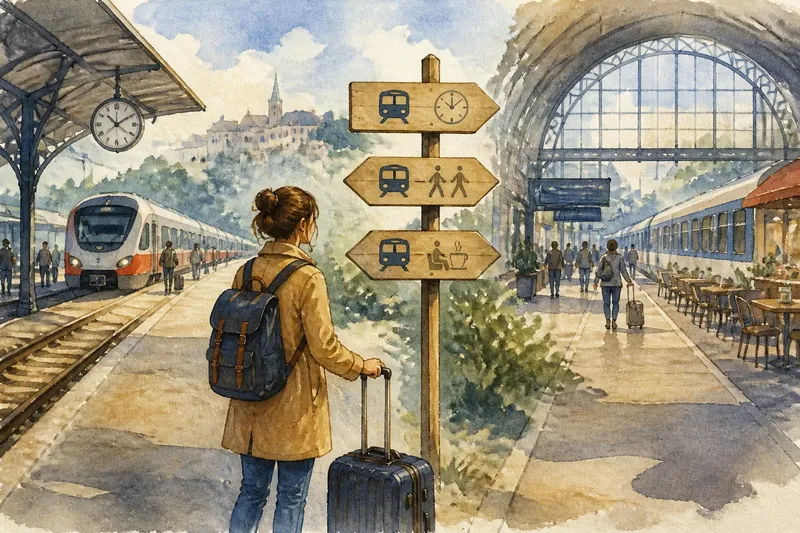
The common mistake when comparing train journeys is choosing the one with the shortest headline duration and treating every connection as a minor detail. A tight transfer, a long wait, or a station change can shape the whole day, affecting how much time you have at your destination and how settled you feel when you arrive.
Train connections are not just gaps between services. They are transitions between platforms, stations, luggage arrangements, and expectations. Compare the full journey around your own priorities: predictable arrival, a calm pace, fewer transitions, or useful flexibility if the day does not go exactly to plan.
What should you compare besides the timetable duration?
Start with the itinerary’s actual sequence. Note where each train departs and arrives, whether the change happens at the same station, and how long the connection leaves you. Then consider what you will need to do during that interval: find a platform, move between stations, use a restroom, get food, or manage bags.
Two routes with similar scheduled durations can feel very different. One may involve a direct transfer between platforms; another may leave you waiting in a large station or require a trip across town. A timetable is like a recipe that lists the cooking time but not the prep: the headline duration omits some of the effort that makes the day work.
- Count the changes. Each one adds a transition and another point where the itinerary depends on a connection working.
- Check the station names. Similar names do not always mean the same building or a convenient transfer.
- Look at the connection interval. Ask whether it leaves room for the specific station and transfer involved.
- Consider the time of day. A wait may suit you during a meal break but feel burdensome late at night.
- Check arrival timing. An earlier arrival may be useful only if your plans, accommodation, or onward transport can make use of it.
These details turn route comparison into a decision about the day you want, rather than a contest between two durations.
Which route fits your travel situation?
When is a direct train the better fit?
Choose a direct service when you want fewer transitions, are carrying awkward luggage, or would rather stay settled than change trains. It can also suit a day with a fixed arrival commitment, because there is no planned interchange to manage. Still, check the service pattern and arrival time: a direct route is not automatically the most useful one if it arrives at an inconvenient hour.
When does one change make sense?
A single change can be a good fit when it gives you a substantially more convenient departure or arrival, or breaks a long stretch into manageable parts. Look for a connection at the same station with a clearly workable interval. If the change involves another station or a complicated transfer, treat that as a separate journey segment rather than a simple platform swap.
Who benefits from a longer connection?
A longer interval can suit travelers who prefer time to orient themselves, want a proper meal break, or would be uncomfortable rushing through an unfamiliar station. It may also make sense when the transfer itself is a meaningful part of your plan. The trade-off is time spent waiting, so decide whether that pause helps your day or consumes time you would rather spend elsewhere.
When are several changes worth considering?
Multiple changes may fit a traveler whose priority is reaching a particular stop or whose schedule allows room for transfers. They are harder to fit into a day with tight plans, lots of luggage, or little appetite for repeated decisions. Compare the whole chain, including each station transition, instead of assuming that a series of short legs will feel easy.
How much connection time feels workable?
There is no single interval that fits every interchange. A same-platform transfer in a familiar station is different from moving between distant platforms in an unfamiliar building. A change between separate stations is different again, especially if it requires local transport, walking outside, or passing through busy streets.
Check the station’s official information for its layout and any stated transfer guidance. Look for the arrival and departure platforms if available, the station entrances, and whether the route requires leaving the station. Also consider your own pace, luggage, mobility needs, and whether you are traveling with someone who needs extra time.
Imagine you are choosing between a route with a brief same-station change and one with a longer wait at a station where you can sit and eat. If you are carrying a large suitcase and would rather not hurry, the longer connection may be the better match, even though it extends the scheduled journey. The observable difference is a less compressed transfer, not a promise that the entire trip will be stress-free.
When a connection is tight, ask what happens if the first train arrives late and what your options are for continuing. Do not assume every ticket or operator handles missed connections the same way. Where ticket conditions or station arrangements determine the answer, check the relevant operator’s information before choosing.
What should you check before choosing a route?
Does a station change require leaving the building?
Check the exact station names and locations rather than relying on a city label in the journey planner. If the itinerary uses separate stations, identify how you would get between them and allow for the transition as part of the journey. A change across town is not equivalent to changing platforms.
Will the waiting time work for your day?
Consider the hour, your arrival condition, and what you can comfortably do in that interval. A wait that gives you time for food may be useful; one that leaves you idle after a late arrival may not. Use the station’s facilities and opening information to judge the pause, rather than assuming every station offers the same options.
What if you are traveling with a companion?
Agree on a pace that works for everyone, especially if someone needs more time to walk, read signs, or handle luggage. A route that is simple for one traveler can become rushed when the group has different needs. Choose the connection with the whole party in mind.
How should you compare two nearly equal routes?
Write down each route’s number of changes, station transitions, connection intervals, arrival time, and likely waiting conditions. Then rank the items that matter most to you and choose the route that meets those priorities. This makes the trade-off visible instead of letting the shortest duration decide by default.
How can you make the final choice?
Use a simple priority order. First decide what the day cannot compromise: a particular arrival time, an easier journey with bags, or a calm transfer. Next remove routes that plainly conflict with that need. Among the remaining options, compare the connection pattern and choose the one whose waiting and transitions you can accept.
For example, say you have a morning appointment near your destination and two trains arrive before it. One has a shorter timetable duration but a tight transfer at an unfamiliar station; the other takes longer and changes at a station you know. If arriving with time to orient yourself matters more than the earliest possible arrival, the second itinerary may fit better. Check the actual arrival and onward route before booking so the appointment plan rests on the full trip, not just the train schedule.
Keep your chosen itinerary easy to use on the day. Save the station names, departure times, and platform information where you can find them, and leave room to check live service updates. Those small preparations do not remove delays, but they make the planned transitions clearer.
When comparing train routes, treat connection time as part of the experience rather than empty space between departures. The best fit may be direct, may include a useful pause, or may trade a faster schedule for an easier station transfer. Choose according to how you want the day to unfold, and verify the connection details before you commit.