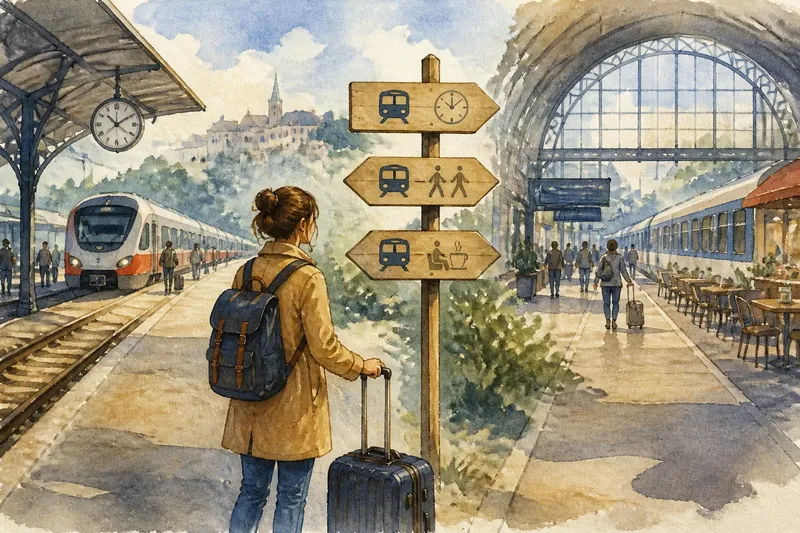
The One-Anchor Itinerary: Planning Around a Single Fixed Point
A one-anchor itinerary protects one time-specific commitment and shows how much of your travel day can remain open for meals, detours, and rest.
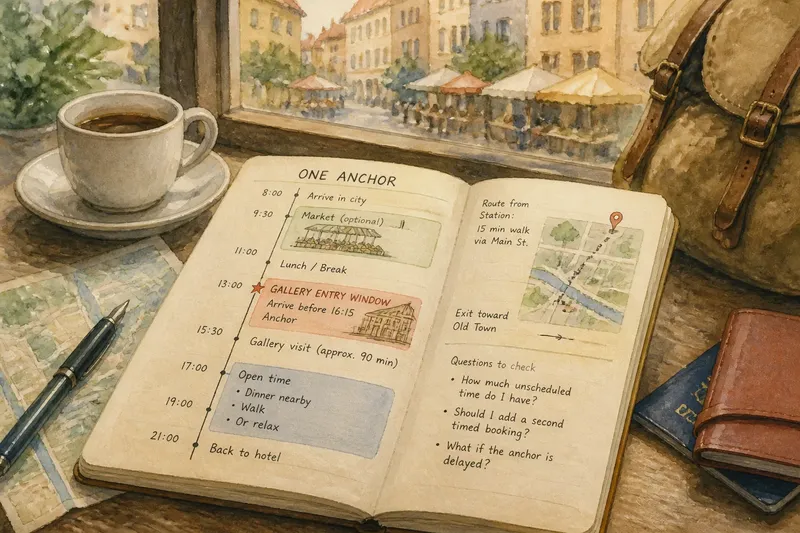
The common mistake in building a travel day is booking activities around the one thing that already has a fixed time. That can leave you rushing from one reservation to another, or paying for plans you cannot comfortably reach. A one-anchor itinerary starts with the fixed commitment, then treats the hours around it as available space rather than empty slots that must be filled.
That distinction matters when a day includes a timed museum entry, a performance, a guided walk, or a dinner reservation. You can see what the commitment actually requires, protect the time needed to reach it, and decide later whether the rest of the day calls for another plan or a slower pace.
What counts as the anchor?
An anchor is a commitment that has a specific time and is difficult or inconvenient to move. It might be a concert with a set start, a ferry departure, a booked tour, or a timed admission window. A loose intention such as “see the old town” is not an anchor because you can change its timing without losing a reservation.
Choose one anchor for the day you are planning. If you have several fixed commitments, each will shape the available time, and the day may not have enough flexibility for this method to help much. For this approach, identify the commitment that matters most and use it as the point around which the rest of the day takes shape.
Write down what the booking requires, not just the event’s advertised start time. Check the arrival instructions, entry window, location, and any stated closing or check-in conditions. Booking terms and venue directions determine what time you need to be present; when those depend on the provider’s instructions or local rules, follow those instructions.
How do you build the day around it?
Start with the anchor’s required arrival time. Then mark the time needed to get there from wherever you expect to be, allowing for the actual route and the way you plan to travel. The point is not to add a universal buffer, but to account for the transfer you will really make: walking with luggage, changing transit lines, or crossing a large venue can take different amounts of effort.
Next, mark the time you expect to spend at the commitment. If its duration is not stated, use a reasonable estimate based on the activity and leave room for the end to run late. Keep the exit route in mind too. A performance may finish when a nearby restaurant is busy, while a tour may leave you on the opposite side of town from your next preferred stop.
Now mark the time after the anchor that must remain usable. Include the trip to your lodging, a necessary meal, or a connection you cannot miss. What remains is your open time. That is the part of the day where you can choose an activity, take a rest, or simply decide later.
Think of the anchor as a bookend holding a loose stack of papers in place. The pages do not need to be arranged in a rigid order; you only need to keep the essential edge from slipping. In an itinerary, the fixed commitment holds the day together while the open hours stay adjustable.
What belongs in the open time?
Use the open time for plans that can be shortened, skipped, or moved. A neighborhood walk, a market visit, a café stop, or a museum without a timed entry can fit more easily than another reservation across town. Choose something near the anchor or along the route to it when that makes the day simpler.
It helps to distinguish between a preference and a requirement. “I’d like to see the riverside” can remain optional; “I need to collect my room key before the desk closes” belongs in the fixed part of the plan. If two optional ideas compete for the same open stretch, keep the one that is easiest to leave unfinished.
Do not assign every free hour a task just because the calendar has space. Time for a meal, a quiet break, or an unplanned discovery can be the most useful part of a day, especially after a journey or a long event. An open block is a real choice, not a planning failure.
How does the method work in a real itinerary?
Say Maya is visiting a city and has a timed gallery entry in the late afternoon. Imagine her booking says to arrive before the entry window closes, and the gallery is a walk from the central train station. She wants to see a covered market and have dinner nearby, but neither plan has a reservation.
Maya first notes the required arrival time and the route from the station. She keeps the gallery visit as the day’s anchor, adds the expected visit duration, and leaves the market and dinner unbooked. She places the market before the gallery because it is on the way, then treats the time after the visit as open rather than promising herself a second attraction.
At the station, Maya finds that her train arrives later than she expected. Because the market was optional, she can head straight toward the gallery without losing a prepaid activity. After the visit, she can choose a nearby dinner spot or take a break first; the visible result is a day that still works even though one preferred stop disappears.
The lesson is not that every city day should follow Maya’s route. It is that optional plans should be the first things to move when the fixed point consumes more time than expected. If her train had arrived early, the market would have remained available; if the gallery ran long, the day would not have collapsed around a chain of bookings.
Which questions help you judge the plan?
How much unscheduled time do I really have?
Subtract the anchor’s arrival and duration, the necessary travel on either side, and any immovable obligation. The remainder is your usable open time, not the full stretch between waking and bedtime.
Should I add a second timed booking?
Add one only if the route and likely finish time leave enough room to reach it without turning the anchor into a race. If the second booking would force you to leave the first early or skip a needed meal, keep it for another day.
What if the anchor is canceled or delayed?
Keep a simple substitute in mind, such as a nearby walk, a café, or a place you can visit without a reservation. Check the cancellation notice or provider’s message before deciding what to do, since the available options depend on the booking terms.
Can a whole trip have one anchor?
Yes, but use the idea day by day rather than trying to make one event organize the entire trip. A multi-day plan can have a different fixed point on each day, with less scheduled time on days that already include a long transfer or demanding activity.
How can you keep the plan flexible on the day?
Save the anchor’s address, arrival instructions, and route somewhere easy to reach offline, such as a map saved on your phone or a note. Keep optional ideas in a separate list so they do not look like obligations when you check the day’s schedule.
Before leaving, make a quick decision based on how you feel and what time it is: take the optional stop, shorten it, or skip it. You do not need to rebuild the entire itinerary each time conditions change. Protect the anchor, then adjust the loose parts.
A one-anchor itinerary is useful precisely because it shows the difference between time you have and time you can spend. The next time you plan a city day, write down the fixed point first, account for the trip to and from it, and leave the remaining space visibly open. That simple view can help you choose a plan that fits the day you actually have.